Starting a resistance training routine is one of the most effective steps you can take to support muscle function, improve joint stability, and enhance everyday energy as you age. Yet, for many adults over 50 or those returning to fitness after a break, the idea of stepping into a crowded commercial gym or lifting heavy barbells can feel overwhelming. The good news is that you do not need expensive gym memberships or complicated equipment to build lasting functional strength. A simple pair of light dumbbells in your living room is all it takes to build a safe, effective full-body routine.
💡 Welcome Fitness Beginners & Adults Over 50
Whether you are 45, 58, or 67, your body responds positively to gentle resistance exercise. Progress in strength training is not about pushing to exhaustion; it is about establishing consistent, comfortable movement patterns that support your daily activities—like carrying groceries, climbing stairs, and standing up with ease.
📋 Table of Contents
(Tap to expand)
- Common Beginner Concerns & Friendly Advice
- Why Dumbbell Training Is Ideal for Home Fitness & Active Aging
- Choosing Your First Dumbbells for Home Use
- The 5-Movement Full-Body Beginner Dumbbell Workout
- Weekly Workout Schedule & Rest Guidelines
- 8-Week Beginner Progression Plan
- Scientific References & Authoritative Sources
Common Beginner Concerns & Friendly Advice
If you feel nervous about starting a strength workout, know that these feelings are entirely normal. Here is practical encouragement for common beginner worries:
- “I have never lifted weights before:” Everyone starts at the beginning. Focus purely on movement form with light weights (3 to 5 lbs). Bodyweight practice is completely acceptable as you learn.
- “I am worried about getting injured:” Injury occurs from using excessive weight or rushing form. Moving slowly (2 seconds up, 2 seconds down) and keeping weights near your body keeps joint stress minimal.
- “I only have small 3 lb or 5 lb dumbbells:” Light dumbbells are perfect! Building muscle endurance and joint confidence with light resistance yields tremendous functional benefits for beginners.
- “I cannot complete all exercises or repetitions yet:” Complete what feels comfortable. Doing 5 repetitions instead of 8 is still a victory. Build volume gradually over time.
Why Dumbbell Training Is Ideal for Home Fitness & Active Aging
Clinical consensus from the American College of Sports Medicine (ACSM) and the National Institute on Aging (NIA / NIH) emphasizes that regular resistance exercise helps preserve lean muscle mass and bone density. Dumbbells offer unique advantages for beginners:
- Joint-Friendly Natural Freedom: Unlike fixed machine tracks, dumbbells allow your wrists, elbows, and shoulders to move along your natural joint pathways.
- Balanced Muscle Activation: Working with separate weights in each hand prevents your dominant side from compensating for weaker muscles.
- Living Room Convenience: A set of dumbbells requires virtually zero storage space and can be stored in a closet or under a bed.
⚠️ Safety First: Key Rules Before You Begin
- Warm Up First: Always spend 3 minutes performing light dynamic movements (arm circles, gentle torso twists) before lifting weights.
- Never Hold Your Breath: Inhale as you lower the weight; exhale steadily during the working effort.
- Controlled Movement: Lift for 2 seconds and lower under control for 2 seconds. Never swing weights.
- Listen to Your Joints: Muscle tiredness is normal, but sharp joint pain is a signal to stop. Consult your primary physician before starting if you have chronic joint conditions or cardiovascular history.
Choosing Your First Dumbbells for Home Use
Selecting the right equipment keeps workouts safe and comfortable. Here is a practical buying guide for setting up your home workout space on a budget:
1. Fixed vs. Adjustable Dumbbells
- Neoprene or Rubber-Coated Fixed Dumbbells (Recommended for Beginners): Soft-textured coatings provide a non-slip grip even with sweaty palms and protect home flooring.
- Adjustable Dial Dumbbells: Excellent space-saving option if multiple family members share equipment, though slightly bulkier for upper-body movements.
2. Starting Weight Guidance for Adults Over 50
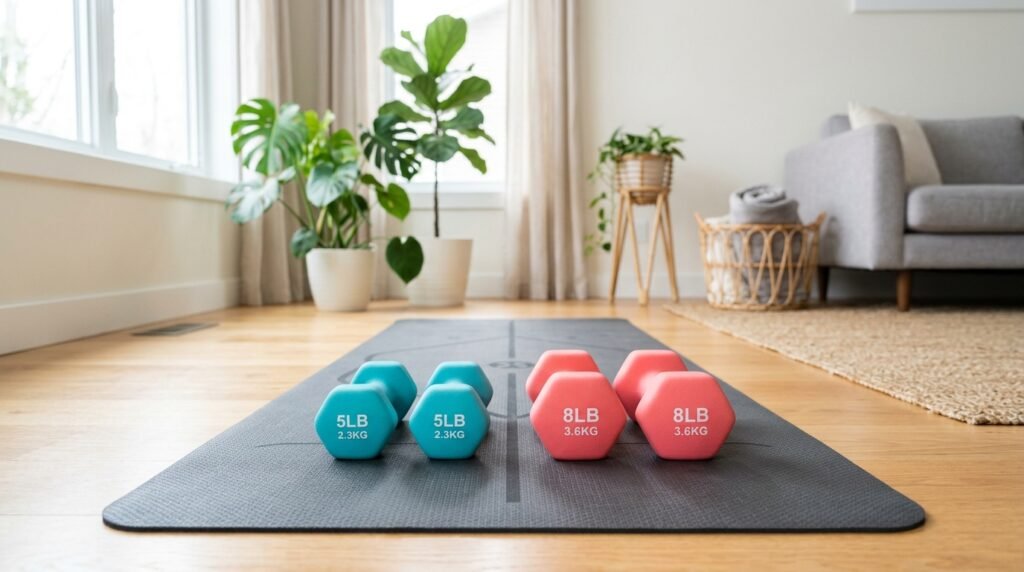
When selecting your initial weight, follow the 2-Repetition Reserve Rule: your chosen weight should allow you to complete 10 repetitions with clean form, feeling like you could safely complete 2 more reps if needed.
- Upper-Body Exercises (Rows, Chest Press, Curls): Start with 3 lb, 5 lb, or 8 lb dumbbells.
- Lower-Body Exercises (Squats, Deadlifts): Start with 5 lb, 8 lb, or 10 lb dumbbells.
The 5-Movement Full-Body Beginner Dumbbell Workout
Perform this routine 3 days per week (e.g., Monday, Wednesday, Friday) with at least one rest day between sessions.
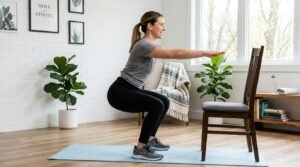
1. Chair Squat with Dumbbell Hold
- Muscles Involved: Quadriceps, Gluteus Maximus, Core
- Starting Position: Stand tall directly in front of a dining chair with feet shoulder-width apart. Hold one 5 lb to 10 lb dumbbell vertically against your chest with both hands.
- Step-by-Step Instructions: Inhale as you push your hips back and bend your knees as if sitting into the chair. Lightly touch your buttocks to the seat edge without relaxing weight. Exhale as you press firmly through your heels to stand tall.
- Common Mistakes: Letting knees collapse inward or allowing heels to lift off the floor.
- Beginner Modification: Perform without dumbbells (bodyweight only) or use a higher seat cushion.
- Prescription: 2 Sets | 8 to 10 Repetitions | 60 Seconds Rest
2. Dumbbell Bent-Over Row (Extra Form Guidance)
- Muscles Involved: Latissimus Dorsi, Rhomboids (Upper Back), Rear Deltoids, Biceps
- Starting Position: Stand with feet hip-width apart holding a 3 lb to 5 lb dumbbell in each hand. Hinge forward at your hips 45 degrees, maintaining a flat neutral spine and soft knee bend. Let arms hang straight down naturally.
- Step-by-Step Instructions: Inhale to prepare. Exhale as you pull your elbows back past your ribcage, squeezing your shoulder blades together at the top. Pause for 1 second, then lower weights under 2-second control.
- Common Mistakes: Rounding the upper back or jerking the torso upward to create momentum. Keep your chest open and neck aligned with your spine.
- Beginner Modification: Place one hand and one knee on a sturdy chair seat for single-arm supported rows.
- Prescription: 2 Sets | 10 Repetitions | 60 Seconds Rest
3. Standing Dumbbell Chest Press / Incline Wall Press
- Muscles Involved: Pectorals (Chest), Anterior Deltoids, Triceps
- Starting Position: Stand tall or lie flat on an exercise mat holding dumbbells at chest height, elbows bent at 45-degree angles to your torso (not straight out).
- Step-by-Step Instructions: Exhale and press dumbbells straight up above your chest until arms are fully extended (without locking elbows). Lower under control while inhaling.
- Common Mistakes: Flaring elbows straight out to 90 degrees, which strains shoulder joints. Keep elbows at a slight angle.
- Beginner Modification: Perform standing incline wall push-ups if lying down on the floor is uncomfortable.
- Prescription: 2 Sets | 8 to 10 Repetitions | 60 Seconds Rest
4. Dumbbell Romanian Deadlift Hinge (Extra Form Guidance)
- Muscles Involved: Hamstrings, Glutes, Erector Spinae (Lower Back)
- Starting Position: Stand upright holding dumbbells in front of thighs, shoulders pulled back, knees slightly soft (not locked).
- Step-by-Step Instructions: Inhale as you push your hips backward (like closing a car door with your glutes) while sliding dumbbells down close to your shins. Keep your spine flat. When you feel a gentle hamstring stretch, exhale, squeeze glutes, and drive hips forward to stand tall.
- Common Mistakes: Bending at the waist or allowing the lower back to round. The movement comes from pushing hips back, not squatting down.
- Beginner Modification: Practice hip hinging with hands placed on hips or against a wall before adding weights.
- Prescription: 2 Sets | 8 Repetitions | 60 Seconds Rest
5. Standing Biceps Curl to Overhead Shoulder Press (Extra Form Guidance)
- Muscles Involved: Biceps, Anterior/Lateral Deltoids (Shoulders), Upper Trapezius
- Starting Position: Stand tall holding light 3 lb to 5 lb dumbbells at your sides, palms facing forward, feet hip-width apart.
- Step-by-Step Instructions: Exhale as you curl weights to shoulder height. Rotate palms forward and smoothly press dumbbells overhead until arms extend. Inhale as you lower back to shoulders, then uncurl to starting position.
- Common Mistakes: Arching the lower back or leaning backward during the overhead press. Tighten your core and keep ribs down.
- Beginner Modification: Perform seated in a firm, supportive dining chair to isolate upper body mechanics.
- Prescription: 2 Sets | 8 Repetitions | 60 Seconds Rest
Weekly Workout Schedule & Rest Guidelines
📅 Sample Weekly Beginner Routine
| Day | Activity | Focus / Goal |
|---|---|---|
| Monday | 20-Min Full-Body Workout | Complete 5 Dumbbell Exercises (2 Sets) |
| Tuesday | 30-Min Light Walking / Mobility | Active Recovery & Joint Flexibility |
| Wednesday | 20-Min Full-Body Workout | Complete 5 Dumbbell Exercises (2 Sets) |
| Thursday | Rest & Hydration Day | Muscle Fiber Repair & Relaxation |
| Friday | 20-Min Full-Body Workout | Complete 5 Dumbbell Exercises (2 Sets) |
| Weekend | Outdoor Walking & Family Activity | Enjoyable Outdoor Movement |
8-Week Beginner Progression Plan
Sustainable progress requires a gradual approach. Follow this structured 8-week timeline:
- Weeks 1–2 (Learning Movement Patterns): Perform 2 sets of 8 reps per exercise using very light weights. Focus on breathing and form.
- Weeks 3–4 (Building Muscle Stamina): Increase volume to 2 or 3 sets of 10 to 12 reps while keeping weights constant.
- Weeks 5–8 (Gradual Resistance Increase): When 12 reps feel comfortable, increase dumbbell weight by 1 to 2 lbs (e.g. moving from 5 lbs to 7 lbs) and reset to 8 reps.
📚 Related Fitness, Recovery & Nutrition Reading:
- Strength Training for Beginners Guide – Core principles of muscle preservation.
- Beginner-Friendly Exercise Routines – Structuring full-body weekly workout schedules.
- Best Muscle Recovery Tools for Desk Tension – Managing post-workout muscle soreness.
- The Best Massage Guns on Amazon Guide – Comparing percussive therapy devices.
- Healthy Aging & Brain Health Master Guide – Long-term mobility and active longevity.
- 10 Principles of Healthy Weight Management – Fueling workouts with dietary protein.
🩺 Medical Disclaimer
The wellness information, guides, and suggestions provided in this article are for educational and motivational purposes only. This content is not a substitute for professional medical advice, diagnosis, treatment, or therapy. Always consult with a qualified healthcare professional or physician before starting any new diet, fitness program, or wellness plan.
Scientific References & Authoritative Sources
- American College of Sports Medicine (ACSM): Quantity and Quality of Exercise for Developing and Maintaining Fitness in Apparently Healthy Adults. Medicine & Science in Sports & Exercise.
- Centers for Disease Control and Prevention (CDC): Physical Activity Guidelines for Americans: Resistance Training for Older Adults. Available at: cdc.gov/physicalactivity
- National Institute on Aging (NIA / NIH): Exercise and Physical Activity Guidelines for Healthy Aging. Available at: nia.nih.gov/health/exercise-and-physical-activity
Combine strength work with beginner exercise routines for optimal health.