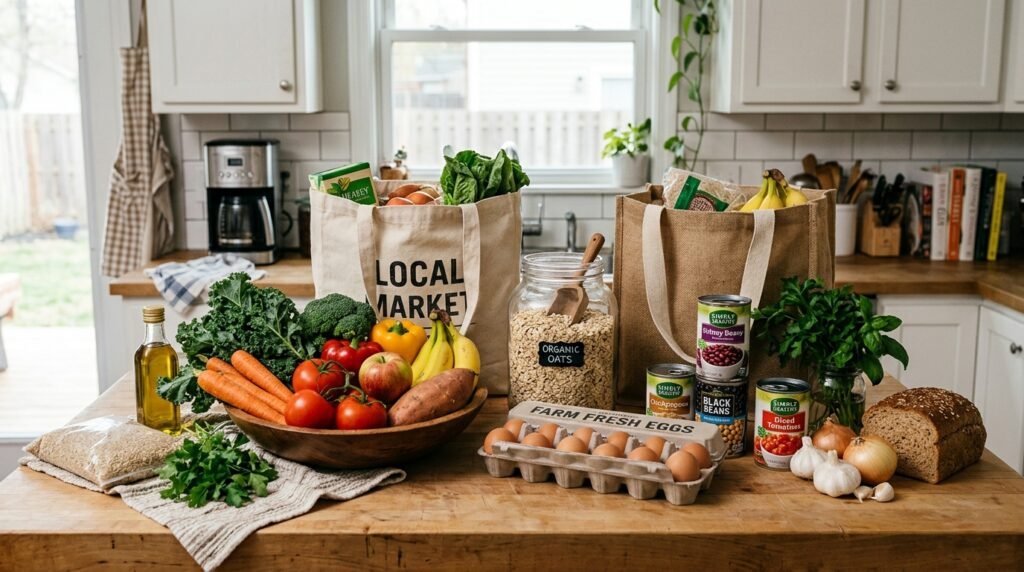
Navigating food price inflation while trying to feed your family nutritious, wholesome meals can feel like a constant balancing act. Many American shoppers assume that healthy eating requires buying expensive gourmet items or shopping exclusively at specialty health food stores. However, clinical guidance from the USDA MyPlate program and the Dietary Guidelines for Americans underscores that nutrient-dense eating relies on affordable, unrefined staples available at standard US supermarkets like Walmart, Aldi, Kroger, Target, and Costco. With a clear shopping strategy and smart pantry planning, you can nourish your family with wholesome meals without overspending.
💡 Illustrative Family Scenario: Maria’s Grocery Strategy (Texas)
Note: The following scenario is an illustrative example demonstrating real-world budgeting principles.
- Family Structure: 2 adults and 2 children managing a fixed monthly household food budget.
- Main Challenge: Reducing weekly supermarket spending by $40 while serving balanced, protein-rich family dinners.
- Applied Strategy: Replaced out-of-season fresh berries with flash-frozen berries, used dried black beans and lentils to double ground turkey in chili, bought private-label store brands, and planned dinner menus around weekly store circular sales.
📋 Table of Contents
(Tap to expand)
- The Myth of Expensive Healthy Eating
- Aisle-by-Aisle Budget Grocery Choices & Buying Tips
- Fresh vs. Frozen vs. Canned Produce: What Saves the Most Money?
- Where Organic Spending Makes the Most Sense
- Food Safety & Kitchen Waste Reduction Guidance
- Sample $100 Weekly Grocery Strategy for a Family of Four
- Frequently Asked Questions About Budget Healthy Grocery Shopping
- Scientific References & Authoritative Sources
The Myth of Expensive Healthy Eating
Marketing campaigns often promote high-cost superfood powders and exotic ingredients, creating the false impression that clean eating is out of reach for average household budgets. In reality, core human nutrition depends on foundational whole foods: complex carbohydrates, lean and plant-based proteins, healthy fats, and essential vitamins and minerals. Buying whole, minimally processed ingredients in basic forms yields maximum nutrition per dollar spent.
Aisle-by-Aisle Budget Grocery Choices & Buying Tips
📊 Scannable Aisle-by-Aisle Budget Guide
| Category | Budget-Friendly Choices | Smart Buying Tip |
|---|---|---|
| Produce | Bananas, carrots, sweet potatoes, frozen spinach/berries | Buy seasonal produce fresh; buy out-of-season produce frozen. |
| Protein | Large eggs, canned tuna, bone-in chicken thighs, dry lentils | Compare price per pound/ounce rather than package cost. |
| Pantry | Rolled oats, brown rice, canned black beans, peanut butter | Purchase family-size tubs of oats and rice to save 30–40%. |
| Dairy | Plain Greek yogurt, store-brand milk, cottage cheese | Choose private-label store brands for identical nutrition. |
| Frozen Foods | Frozen green beans, peas, corn, frozen fish fillets | Flash-frozen items lock in nutrition with zero food waste. |
| Healthy Snacks | Air-popped popcorn kernels, sunflower seeds, raisins | Avoid single-serve snack pouches; portion out from bulk bags. |
Fresh vs. Frozen vs. Canned Produce: What Saves the Most Money?
A common misconception is that fresh produce is always superior to frozen or canned options. According to USDA nutrition research, flash-freezing vegetables immediately after harvesting preserves nutrient levels equal to—and sometimes higher than—fresh produce that has traveled long distances in trucks.
Figure 1: Fresh vs. Frozen vs. Canned Produce Nutritional Parity & Budget Comparison Guide
- When to Buy Fresh: In-season produce (e.g. summer berries, fall apples) and items consumed raw (salads, cucumbers).
- When to Buy Frozen: Out-of-season fruits, smoothie ingredients, and cooking veggies (broccoli florets, green beans, corn).
- When to Buy Canned: Legumes (chickpeas, black beans) and low-sodium diced tomatoes for sauces and stews. Always rinse canned beans to reduce sodium by up to 40%.
Where Organic Spending Makes the Most Sense
As explored in our detailed guide on Why Choosing Organic Foods Matters for Your Family, buying organic is a personal preference rather than a strict requirement for health. Organic foods are not inherently more nutrient-dense than conventionally grown whole foods. When managing a tight household budget, prioritize your spending using the Environmental Working Group (EWG) guidelines:
- Save Money on Conventional (Clean 15): Produce with thick outer skins or low pesticide absorption (avocados, sweet corn, pineapples, onions, sweet potatoes, cabbages, frozen peas) carries minimal residue. Buying conventional options here saves 30% to 50%.
- Consider Organic If Budget Allows (Dirty Dozen): Produce consumed with skin intact (strawberries, spinach, apples, grapes, cherries). If organic prices are prohibitive, thoroughly washing conventional produce under cold running water remains safe and effective.
Food Safety & Kitchen Waste Reduction Guidance
Reducing food waste is the single most effective way to stretch your food budget. Practicing proper food safety preserves both health and household dollars:
- Maintain Safe Refrigerator Temperatures: Set your refrigerator to 38°F (3.3°C) or below and freezer to 0°F (-18°C) to slow bacterial growth and extend shelf life.
- Safe Handling of Raw Poultry & Meat: Store raw meat on the lowest refrigerator shelf in sealed containers to prevent juices from dripping onto fresh produce. Wash cutting boards thoroughly with hot soapy water after raw meat prep.
- Washing Produce Correctly: Rinse all fresh fruits and vegetables under cold running water just before preparing or eating. Avoid using dish soap or bleach rinses.
- Storage of Leftovers & FIFO Method: Store cooked leftovers in airtight glass or BPA-free plastic containers within 2 hours of cooking, consume within 3 to 4 days, and practice FIFO (First In, First Out) by moving older items to the front of the fridge.
- Clear Freezer Labeling: Label freezer bags with the item name and date. Ground meat lasts 3 to 4 months frozen; berries and vegetables last up to 8 to 12 months.
Sample $100 Weekly Grocery Strategy for a Family of Four
Here is a realistic, nutrient-dense weekly shopping plan for a US family of four shopping at value retailers like Aldi or Walmart:
🛒 Sample $100 US Family Master Grocery Plan
Proteins ($32 Total):
- 2 Cartons Large Eggs (24 count) — $5.50
- 1 Pack Family Chicken Thighs (4 lbs) — $7.50
- 4 Cans Light Tuna — $4.80
- 2 Bags Dried Black Beans & Brown Lentils (2 lbs) — $3.20
- 1 Tub Plain Greek Yogurt (32 oz) — $3.80
- 1 Jar Peanut Butter (30 oz) — $2.70
- 1 Block Tofu or Cottage Cheese — $2.50
Produce ($34 Total):
- 2 Bunches Bananas — $2.80
- 1 Bag Apples (3 lbs) — $3.90
- 1 Bag Carrots (2 lbs) & 1 Bag Yellow Onions (3 lbs) — $4.20
- 1 Bag Sweet Potatoes (3 lbs) — $3.50
- 3 Bags Frozen Vegetables (Spinach, Broccoli, Peas) — $6.00
- 2 Bags Frozen Mixed Berries — $5.60
- 1 Head Cabbage or Romaine Hearts — $3.00
Pantry & Grains ($34 Total):
- 1 Large Tub Rolled Oats (42 oz) — $4.20
- 1 Bag Brown Rice (5 lbs) — $4.50
- 2 Boxes Whole Grain Pasta — $2.80
- 4 Cans Diced Tomatoes & Tomato Paste — $4.00
- 1 Gallon Store-Brand Milk — $3.60
- 1 Loaf 100% Whole Wheat Bread — $2.50
- Spices & Pantry Essentials — $12.40
📋 Printable Budget Healthy Grocery Checklist
Take this categorized checklist on your next grocery trip:
Produce Section:
- ☐ Bananas, apples, oranges
- ☐ Carrots, yellow onions, sweet potatoes, cabbage
- ☐ Frozen spinach, broccoli florets, mixed berries
Protein Section:
- ☐ Large eggs (12 or 18 count)
- ☐ Canned light tuna or salmon
- ☐ Bone-in chicken thighs or whole chicken
- ☐ Plain Greek yogurt & cottage cheese
Pantry & Grains:
- ☐ Old-fashioned rolled oats
- ☐ Brown rice & dry lentils
- ☐ Canned black beans & low-sodium diced tomatoes
- ☐ Natural peanut butter (no added palm oil/sugar)
Dairy & Frozen Foods:
- ☐ Store-brand milk or unsweetened almond milk
- ☐ Frozen green peas, corn, & white fish fillets
Healthy Snacks:
- ☐ Air-popped popcorn kernels
- ☐ Raw sunflower seeds & raisins
Frequently Asked Questions About Budget Healthy Grocery Shopping
What is the cheapest healthy food to buy?
The most affordable nutrient-dense foods per serving include dry black beans and lentils, rolled oats, brown rice, bananas, carrots, large eggs, frozen spinach, and canned light tuna. These supply high amounts of fiber, protein, and essential micronutrients for pennies per serving.
How can a family eat healthy on a tight budget?
A family can eat healthy on a tight budget by building meals around whole-food staples (beans, oats, rice, eggs), checking unit pricing (cost per ounce), purchasing frozen vegetables out of season, choosing retailer store brands, and eliminating pre-cut convenience foods.
Are frozen vegetables healthy?
Yes. Flash-frozen vegetables are harvested at peak maturity and frozen within hours, locking in vitamins, minerals, and antioxidants. Research demonstrates that frozen vegetables are nutritionally equivalent to—and sometimes surpass—fresh produce shipped over long distances.
Is buying organic worth the extra cost?
Organic foods are not mandatory for health. If managing a strict budget, buy conventional produce with thick peels (Clean 15 like bananas, sweet corn, onions, avocados) and prioritize organic only for produce eaten whole (Dirty Dozen like strawberries, spinach, apples) if affordable.
📚 Related Nutrition, Eating Habits & Family Health Reading:
- Principles of Healthy Eating Guide – Understanding macronutrients, fiber, and gut health.
- How to Build Healthy Eating Habits for Life – Kitchen environment design and habit stacking.
- Why Choosing Organic Foods Matters for Your Family – EWG Dirty Dozen & Clean 15 guide.
- 10 Principles of Healthy Weight Management – Energy balance and dietary protein.
- Healthy Aging & Brain Health Master Guide – Active longevity and brain nutrition.
🩺 Medical Disclaimer
The wellness information, guides, and suggestions provided in this article are for educational and motivational purposes only. This content is not a substitute for professional medical advice, diagnosis, treatment, or therapy. Always consult with a qualified healthcare professional or physician before starting any new diet, fitness program, or wellness plan.
Scientific References & Authoritative Sources
- U.S. Department of Agriculture (USDA): MyPlate Household Food Budgeting Guidelines & Nutrient Parity of Processed Produce. Available at: myplate.gov
- U.S. Food and Drug Administration (FDA): Using the Nutrition Facts Label to Make Budget-Friendly Healthy Choices. Available at: fda.gov/food
- U.S. Department of Health and Human Services (HHS): Dietary Guidelines for Americans 2020–2025: Affordable Healthy Eating Patterns.
Related Anti-Inflammatory Plan: Pair your grocery budget list with our Anti-Inflammatory Diet for Beginners Guide.