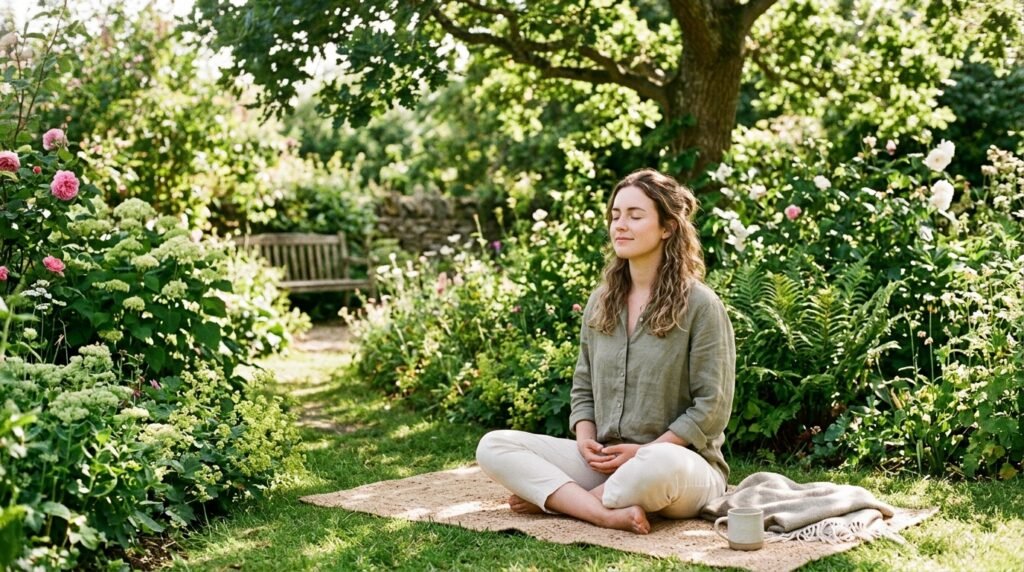
If you often feel overwhelmed by daily demands, tight in your shoulders, or unable to quiet your mind at night, you are experiencing the biological impact of chronic stress. In today’s hyper-connected environment, your sympathetic nervous system—responsible for the “fight-or-flight” response—can remain continuously activated. Over time, elevated cortisol and adrenaline levels disrupt sleep, digestion, metabolic health, and immune function.
💡 Relatable Daily Stress Scenarios
- Scenario A (Workplace Overwhelm): A mid-career professional receives continuous back-to-back notifications. A 2-minute physiological sigh routine resets their heart rate variability before an important meeting.
- Scenario B (Evening Mind Racing): A busy parent struggles to switch off after chores. Practicing a 10-minute digital sunset and warm chamomile tea routine prepares the brain for restful NREM sleep.
- Scenario C (Physical Tension & Tightness): An active senior notices tension in their neck and lower back. Daily gentle walk breaks outdoors in morning light restore natural calm.
📋 Table of Contents
(Tap to expand)
The Biology of Chronic Stress & Cortisol
Stress is not just a mental state; it is a whole-body physiological event. Clinical consensus from the National Institute of Mental Health (NIMH) and Mayo Clinic highlights that acute stress releases cortisol to mobilize glucose for quick energy. However, chronic long-term stress prevents your body from returning to baseline rest-and-digest states (parasympathetic tone).
⚠️ Medical Disclaimer & When to Seek Professional Support
The techniques outlined in this guide are for educational and stress-management purposes only. If you experience severe debilitating anxiety, panic attacks, chest pain, or symptoms of depression, please consult a licensed mental health professional or primary care physician immediately.
12 Evidence-Based Ways to Reduce Stress Naturally
1. Master the Physiological Sigh
Mechanism: Two quick inhales through the nose followed by one long, slow exhale through the mouth instantly offloads carbon dioxide and slows heart rate via the vagus nerve.
2. Get 10–15 Minutes of Morning Sunlight
Mechanism: Morning sunlight exposure triggers early cortisol release, establishing a healthy diurnal cortisol curve that drops naturally by evening.
3. Practice Box Breathing (4-4-4-4)
Mechanism: Inhale for 4 seconds, hold for 4 seconds, exhale for 4 seconds, and hold for 4 seconds. Used by tactical professionals to regain emotional control during high-pressure events.
4. Take a Daily 20-Minute Nature Walk
Mechanism: Research published in Frontiers in Psychology shows that spending 20 minutes in green space significantly lowers salivary cortisol levels.
5. Implement a 60-Minute Digital Sunset
Mechanism: Turning off blue-light screens 1 hour before bed allows your pineal gland to secrete natural melatonin undisturbed.
6. Supplement with Magnesium Glycinate
Mechanism: Magnesium supports GABA neurotransmitter pathways in the brain, promoting muscle relaxation and nervous system calm.
7. Use Progressive Muscle Relaxation (PMR)
Mechanism: Tensing specific muscle groups for 5 seconds and releasing them for 10 seconds trains your brain to recognize physical relaxation signals.
8. Limit Caffeine Intake After 12 PM
Mechanism: Caffeine has an average half-life of 5 to 7 hours, blocking adenosine receptors and elevating resting adrenaline levels into the evening.
9. Engage in Gentle Yoga or Stretching
Mechanism: Slow, mindful stretching stimulates mechanoreceptors in fascia, signaling safety to the autonomic nervous system.
10. Maintain a Daily Gratitude Journal
Mechanism: Writing down 3 specific positive moments daily shifts neural focus away from threat-detection loops in the amygdala.
11. Enjoy Herbal Teas (Chamomile & Passionflower)
Mechanism: Chamomile contains apigenin, an antioxidant that binds to specific brain receptors that decrease anxiety and initiate sleepiness.
12. Establish Consistent Daily Sleep Routines
Mechanism: Going to bed and waking up at the exact same times daily stabilizes your circadian pacemaker, enhancing stress resilience.
📋 Daily Natural Stress Reduction Checklist
- ☐ Step outside for 10 minutes of morning sunlight within 30 mins of waking
- ☐ Perform 3 rounds of physiological sighs during afternoon work breaks
- ☐ Stop caffeine consumption by 12:00 PM
- ☐ Take a 20-minute outdoor walk without staring at your phone screen
- ☐ Turn off digital screens 60 minutes before bedtime
Frequently Asked Questions About Reducing Stress Naturally
What is the fastest way to calm acute stress?
The fastest biological way to calm acute stress is the physiological sigh: take two consecutive deep inhales through your nose, followed by a long, slow exhale through your mouth. Doing this 2 to 3 times rapidly activates your parasympathetic nervous system.
How long does it take for natural stress relief methods to work?
Somatic methods like breathing exercises work within 2 to 5 minutes. Lifestyle habits like morning sunlight, nature walks, and sleep hygiene show compound stress-lowering benefits over 1 to 2 weeks of daily consistency.
🩺 Medical Disclaimer
The wellness information, guides, and suggestions provided in this article are for educational and motivational purposes only. This content is not a substitute for professional medical advice, diagnosis, treatment, or therapy. Always consult with a qualified healthcare professional or physician before starting any new diet, fitness program, or wellness plan.